Click Here to see our custom club selection


More on Shaft Profiles...

"I can't believe how much difference the new shafts made.  Every shot is crisp and consistent."  John M., Houston, TX.

WHATS NEW IN THE SHAFT INDUSTRY

Shafts: The Engine for Your Game

The shaft of the golf club is truly the component that can deliver the most distance, accuracy and feel. With a properly fit shaft, as one of our customers put it, "it's almost like cheating!” In a recent Golf Magazine article, Jesper Parnevik said, "the right shaft gives me an extra 20 yards off the tee, easily." At D'Lance Golf, we spend a lot of time working with our customers, analyzing their swing for loading profile, speed, and tempo. We then come up with the right shaft, club head and grip combination for the best performance. Each shaft throughout your set should be consistent in stiffness, weight and swing weight in order to allow you to swing each club effortlessly.

"Your recommendations were spot on! The stiffer shafts with the softer tip are exactly what I needed." P. Connor, Cheyenne, WY.

Too Soft of Shaft Creates Miss-Hits

What About Re-shafting My Existing Clubs?
" My reshafted Killer Bee driver (reshafted with Fujikura E150 55) works great. Easy to control and most important +15 yds. avg. distance increase. Thanks for a great job." John P., Denver, CO

Over half of our business at D’Lance Golf is in re-engineering or re-shafting existing clubs. In fact, we are so adamant about getting the right shaft that we re-engineer all major manufacturer’s clubs by putting new shafts in them, frequency matching, and swing weighting them to exact specifications..something they simply cannot do due to the volume of their business. In addition, there is a wealth of great shafts in the marketplace today from companies like True Temper, Precision, Grafalloy, Fujikura, MCC Matrix, Mitsubishi Rayon (MRC), Accra, Accuflex, Grahite Design, Aldila and more that are far better quality and offer more weight and launch characteristics to further improve your game.

Testing Shaft and Head Combinations

At D’Lance Golf, we use the Future-Fit Club Conex and Taylor Made Select Fit systems to test different shaft and head combinations. Over 70% of golfers recently polled by Fujikura wanted to be tested on a quick connector system. Once we have determined your optimum shaft flex using the True Temper Shaft Lab, we then select the appropriate shaft material, graphite or steel, based upon your individual profile recommendations, shaft launch characteristics and the appropriate Shaft Flex Index (SFI). If you are looking for new clubs, we then test your swing on the Focaltron Golf Achiever or TrackMan ball flight monitor with different heads to show you the difference in launch angle and shot dispersion with different head characteristics. The major difference at D'Lance Golf is that we can test ANY head, driver, fairway metal, hybrid or iron with a WIDER selection of shafts than offered by the quick connector fitting systems from major OEM's.  D'Lance Golf is an authorized Mizuno Shaft Fitting Center and True Temper Performance Fitting Center.
Head Selection
Shaft Selection

With the appropriate head design, shaft and grip, you will immediately see the difference in distance, shot dispersion and launch angle.

The major elements of shaft fitting are:

  • Length
  • Material (steel, graphite, or nanofuse)
  • Weight
  • Swing Weight
  • Stiffness (Flex)
  • Shaft Profile (Trajectory, Tip Stiffness, Spin Rates)
  • Torque

The most important of these are length, weight, swing weight and stiffness. The material is not a major factor for most players; however, steel shafts are a bit more accurate but are usually heavier. The length of the shaft is determined by among other things, height, stance, and swing plane, while the True Temper Shaft Lab is the tool used to find the correct stiffness.  
By capturing 8,000 data points during the downswing, the PGA Tour proven True Temper Shaft Lab tells exactly how an individual bends the shaft during his/her downswing giving a unique shaft deflection and swing profile. After years of studying many golfers, True Temper has developed proprietary systems to interpret an individual's deflection profile. The more one "deflects" or bends the golf shaft during the downswing, generally the stiffer shaft flex he/ she needs to optimize impact repeatability, which contributes to consistent and accurate shot making.


Personal recommendation with
True Temper Shaft Lab.

From this information, the Shaft Lab computer generates the golfer's swing profile. Each profile is like a fingerprint. No two are alike. This unique profile measures shaft deflection, downswing time, and club head position at impact.

At D’Lance Golf Performance Center, we have tested over 8,000 golfers and determined that there are seven distinct swing profiles, each of which helps us determine the proper shaft.   In addition, the readings from the Shaft Lab are then interpreted and used to recommend the proper shaft weight, swing weight, shaft profile (trajectory and tip stiffness), and very specific shaft flex. From testing thousands of golfers we have found that the Shaft Lab is as accurate as a tenth of a flex. The end result of matching the shaft to the golfer will be golfers performing closer to their maximum capability giving the golfer better feel, greater distance, and increased accuracy. While swing speeds and tempos are important in determining shaft flex, the shaft lab is the only accurate measurement available today for determining pre-impact shaft load.

Mizuno Shaft Optimizer

Another dynamic shaft fitting tool we are using is the Mizuno Shaft Optimizer.  This system uses a test club with sensors, similar to the Shaft Lab, to determine several critical factors about how you load the golf shaft.  From there, Mizuno's system recommends specific shafts that will optimize your performance.

Length

Shaft length is very important in allowing the golfer to maintain a good athletic posture and strike the ball with the center of the club face. If shafts are too short, most shots will be off the toe and to the right of target for right handed golfers. Shafts that are too short will also create poor posture and a tendency to hit the ball thin (hit the ball low and short). If shafts are too long, most shots will be off the heel. Shafts that are too long will also create a tendency to hit behind the ball or push the ball right because the added length also adds weight and makes the club more difficult to swing. At D'Lance Golf, we spend a lot of time measuring golfers both statically (using wrist crease-to-floor- measurements) and dynamically (using impact tape on the face of the club) to accurately determine the correct length for our golfers.

Material (steel, graphite, or other)

Shafts come in either graphite, steel or a hybrid mix of graphite and steel (Adams Golf and True Temper made this popular). In general, steel shafts are heavier than graphite. Since lighter weight shafts create faster swing speeds and deliver mass more quickly to the ball, graphite is the choice of shaft in drivers and fairway woods to maximize distance. In the past two years, there have been some very innovative new lightweight steel shafts like the True Temper Dynamic Gold SL and Dynalite Gold SL. Steel shafts in general are more consistent than graphite when purchased from traditional manufacturers. At D'Lance Golf we custom build clubs in either graphite or steel to exacting tolerances so that our customers will see the same accurate shots whether they are hitting graphite or steel. The only true difference is weight and torque between graphite and steel.

Weight

Weight is a significant factor in determining accuracy, distance and feel in the golf club. Women, juniors and senior golfers have traditionally used graphite in their clubs because they are lighter so it is easier to swing, gets the ball airborne faster and delivers more distance. New, lightweight steel shafts offer more fitting options for golfers that have a low Shaft Flex Index (SFI), or loading factor. For strong, fast swingers with a higher loading factor, heavier shafts will give the golfer a better feel for the club throughout the swing.

Swing Weight

Another factor is swing weight. Unlike club weight, which is the total weight of the club, swingweight is a measure of the balance of the club from grip to clubhead. The swingweight scale usually is measured from C0 to E9 with C0 being the lightest headweight feel and E9 being the heaviest. In general, slower swings with lower SFI's will like the feel of lower swingweights like C5 thru C9 while faster swings with higher SFI's will like the feel of higher swingweights like D2 thru D6. At D'Lance Golf, we use the launch monitors as well as the feedback of the golfer to help determine the correct weight and swingweight that deliver the most accurate, longest shots with the best feel for the golfer.

Stiffness (Flex, Frequency)

Probably one of the most important factors in fitting a golf club is shaft stiffness. The shaft is the only moving part of the golf club. When a golfer swings the club, on the forward swing, the golf club initially is bending in a toe-up position because the club is upside down and the heavy part of the club, the club head, lags behind as the golfer starts pulling the club downward and forward. Just like a tree branch, once you bend the branch and let it go, the branch goes back past center and continues moving back and forth until it stops. The shaft of the golf club does the same thing. This oscillation can be measured using a frequency analyzer that determines the CPM(cyles per minute) of oscillation. In general, for a certain length of shaft, the higher the number of CPM's the stiffer the shaft. A 38 inch 5 iron with a 285 CPM reading is softer than a 38 inch 5 iron with a 292 CPM reading.

Too Stiff Too Soft Perfect!

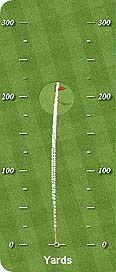
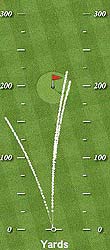
Depending upon the load and acceleration of the golfers swing, the shaft will either load too much and unload too early (shaft is too soft) or not load enough and unload too late (shaft is too stiff) during the golfer's swing. Shafts that are too soft create very erratic shot patterns but usually the shots are high and left of target for right handed golfers. Shafts that are too stiff create two obvious shot patterns: low, left pull shots and high right fade shots. At D'Lance Golf, to precisely fit shaft flex, we use the True Temper Shaft Lab to determine the optimum Shaft Flex Index (SFI) for the golfer's swing. We then correlate that to actual shot dispersion patterns using the Golf Achiever launch monitor to determine the exact stiffness (SFI) that creates the tightest shot dispersion and maximum distance. We then custom BUILD each club to the exact frequency that matches the golfers SFI.

Shaft Profile (Trajectory, Tip Stiffness, Spin Rates)

This is probably the least understood yet extremely important aspect of shaft fitting. For years, shaft characteristics have been defined by the bend point, kick point or flex point.  All of this has changed.  It is now possible to select shafts that have a variety of shaft stiffness; both butt and tip, as well as variable trajectories, low, mid or high.  In addition, more advanced shaft materials have allowed us to reduce or increase the spin rate of the ball coming off the clubface.

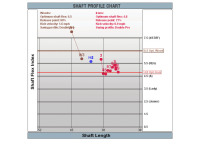
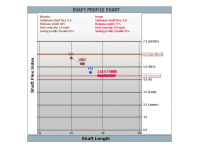
Because of this, at D'Lance Golf Performance Center we test each shaft using the MCC Shaft Profiler to determine the exact shaft stiffness at both the butt and tip end as well as the stiffest part of the shaft (spine) to determine proper shaft choice and alignment.  We also test the overall integrity of the shaft to determine the quality of manufacture.  If shafts do not meet our tolerances we simply return them to the manufacturer.

In the chart above, the Fujikura Rombax 6W06 has a much stiffer mid section than the Diamana Blue 63, OZIK XCON or ACCRA XT60.  This shaft is designed for lower launch and spin characteristics and golfers that have a very strong release before impact (high kick velocity), and tend to hit the ball high with a lot of spin.  Golfers with a smoother tempo, average launch and spin will have better performance with the OZIK XCON 6 and the Diamana Blue 63.  Golfers looking for higher launch and higher spin, which is good for slower ball speeds, will get better performance from the ACCRA XT60 shaft.

The proper trajectory (low, high or mid) as well as the tip stiffness is determined for the individual golfer based upon the results of the True Temper Shaft Lab analysis and dynamic testing for launch angle, spin rates, and ball speed on our launch monitors.

Torque

One final aspect of shaft fitting is torque, or the amount of twisting a shaft does when a ball is struck. With the advent of larger clubheads, especially in drivers, torque has become an increasingly important consideration. If you tend to be very erratic in hitting shots off the heel and toe of the club, you will be better off with a higher torque shaft (one that twists MORE at impact). The reason for this is something called the "gear effect". When you hit a ball off the toe of the club, the clubhead twists and puts sidespin on the ball. This sidespin actually is in the opposite direction to the twisting of the clubhead(just like a gear). This spin will help draw the ball back to the center of the target area. Similarly, heel shots will also impart sidespin that will fade the ball back to the center of the target area. If the torque of the shaft is too stiff, the clubhead will not twist and will not put much sidespin on the ball. This means the shot will go where the clubface was pointing at impact (Open Face - Right of Target, Closed Face - Left of Target). In general, higher handicap players should opt for higher torque shafts while lower handicap players will benefit from lower torque shafts.

One interesting fitting apsect that we have found is using low torque shafts with softer tip sections for players that like the feel of more "kick" in their shots.  The lower torque actually helps maintain the stability of the shaft even though the tip section is softer for more release at impact.  At D'Lance Golf, we match the golfer's shaft to their ability and desire to create consistent shots as determined on the Golf Achiever launch monitor.

MCC Tip Torsional Resistant (TTR) Technology


Practice Facility | Custom Clubs | Lessons | E-mail Newsletter
Tips & Techniques | Online Pro Shop | Locations
Corporate Programs | Contact Us | FAQ | Links to Partners
Return Home

D'Lance Golf
14 Inverness Drive East #120A
Englewood, CO 80112
Phone: 303-730-2717
Fax: 303-730-2848
Email: info@dlancegolf.com

Web Site Design and Marketing by Webolutions, Inc.


Shaft Tip Too Soft

Mizuno

Shaft Fitting Center