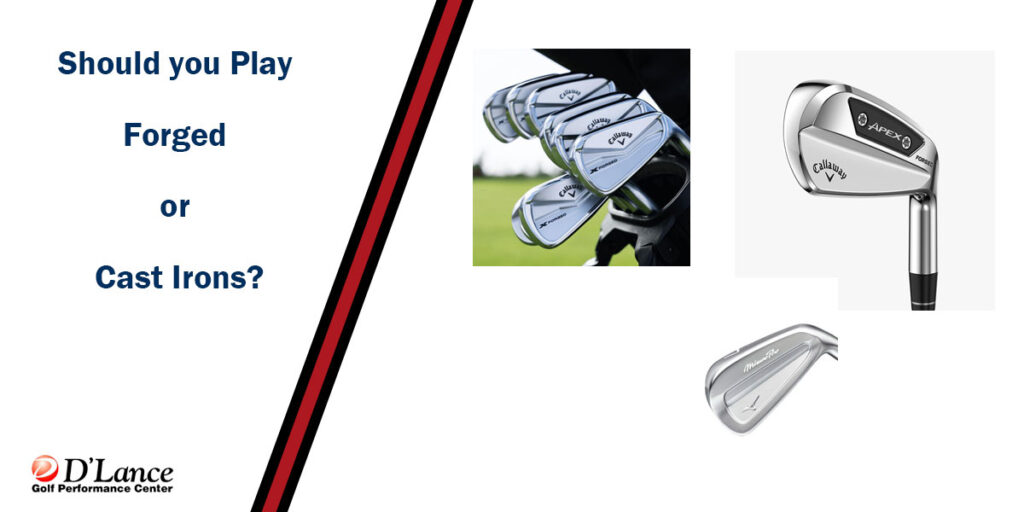
Forged or Cast Irons
The question of “should you play forged or cast irons” is becoming quite a bit less controversial these days due to modern technology. Let’s take a look at what forging and casting processes mean and why they used to be very distinctly different:
Forged Irons
A typical forged iron is made from a single piece of soft steel called a billet that is heated until it becomes maleable. The billet is then pressed into a shape that can then be ground to a precise shape for that model of iron. This process is time consuming and typically more expensive but can produce irons that have a better feel and performance. The most well-known forged irons are from Mizuno and Miura, both manufactured in Japan. Others that are really strong in the forged iron space are Srixon and Epon, both manufactured in the Endo plant in Japan. New models of irons may have multiple parts that are “forged” but not from the same material. For example, a Callaway APEX iron may have a forged soft steel body for feel, but a forged thin cup-face maraging steel face for more distance.
Cast Irons
The casting process requires a mold for a club head that is filled with molten steel. The mold is allowed to cool and then broken off so that the club can be ground into shape for each iron. This process is fairly fast and economical so these clubs are usually less expensive. Most boxed sets of irons are cast. While these clubs are usually very forgiving, they can have a little harsher feel. Performance can also be less consistent if there is a big tolerance between each iron in terms of loft and lie.
How to Decide in an Iron Fitting
In all of our fittings, we look at the golfers level of play, where they want to go with their game and what time commitment they have for their game. Let’s use the Golf Digest 2025 Hot List definitions of clubs to separate our recommendations:
Super Game Improvement Irons – mostly cast models with a very few forged. Larger, more forgiving irons.
If you are scoring in the 90’s or low 100’s and just looking for more consistency and accuracy, we would start with Game Improvement or Super Game Improvement irons like the Callaway Elyte, TaylorMade Qi 10 or Titleist T350. These are cast irons, less expensive, yet can take a golfer to shooting much lower scores with a proper fitting. The most important aspect for the golfer is look sound and feel.

Ping G440 – Cast Iron
Game Improvement Irons – a few forged combination models (forged body, harder steel face inserts. Large, forgiving irons.
For golfers that are scoring the the low 90’s or 80’s, we would look at Game Improvement or Players Distance irons. These can be either cast like the Callaway Elyte, Mizuno JPX-925 HotMetal, Ping G440 or combination forged body and face like the Callaway Ai 300, TaylorMade P790, Ping i240, or Srixon ZXi 4 or 5. Again, look sound and feel are what the golfer needs to decide.

Mizuno JPX-925 Hotmetal – Cast Iron
Players Distance Irons – mostly forged bodies, forged faces, and hollow body designs. Smaller but still forgiving.
Almost all of the Players Distance irons have forged bodies but many different face plates or inserts. Most popular are the Callaway APEX Ai 150, Ai 200, TaylorMade P790, Ttileist T150, T250 and Srixon ZXi 5. New entrants include the Miura IC-602.

TaylorMade P790 – Forged Hollow Body
Players Irons – almost all forged models. Smaller design with less forgiveness. Typical to blend models for player preferences.
Here is where you start getting players that are definitely looking at a combination of feel and performance. Feel comes from the very soft steel used in the Mizuno S-1 and S-3, the Srixon ZXi 7 and ZXi 5 or Ping Blueprint S and T. It is easy to blend these models so the “cavity back”, more forgiving model is used in the longer irons while the scoring clubs us the muscle-back design. Miura and Epon are known for their soft feel and performance in Players Irons.

Mizuno S3 – 2025 – Pure Forged
Dan Sueltz
And, for low handicap golfers, we stick with Player’s Distance or Player’s
 Loading ...